Tour Schedule:
Year - 2027
Departure Date - aug 17
Return Date - aug 29
This Tour Is Open -
Tour Type - railfan
Tour Pricing:
$5,995 - Double Room Occupancy
$1,275 - Single Room Supplement
$2,000 - Deposit To Hold Space
-$200 - Early Bird Discount
book by oct 15, 2026
Final Payment Due By - may 17, 2027
Tour Includes:
*21 Meals
*Boreas Pass
*5 Workshops
*8 Train Rides
*Alpine Tunnel
*Fully Escorted
*Cumbres Summit
*Georgetown Loop
*11 Railroad Museums
*Cumbres & Toltec RR
*Durango & Silverton RR
Tour hotels:
3 star Courtyard by Marriott
Denver Airport at Gateway Park
Denver, Colorado
3 star Beck Inn
Breckenridge, Colorado
3 star Holiday Inn Express & Suites
Gunnision, Colorado
3 star Best Western Plus Rio Grande Inn
Durango, Colorado
2 star Branding Iron Motel
Chama, New Mexico
3 star Great Western Colorado Lodge
Salida, Colorado
3 star Holiday Inn Express & Suites
Golden, Colorado
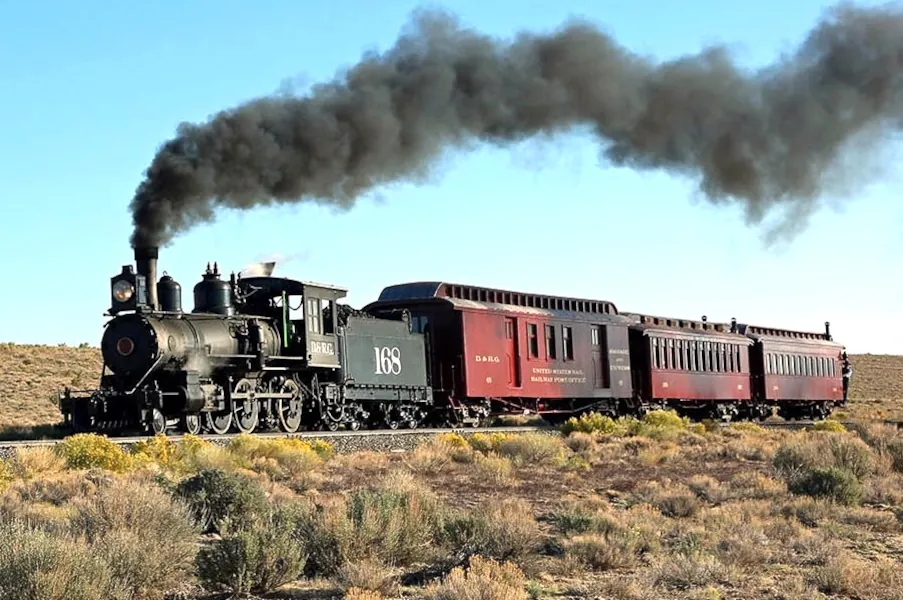
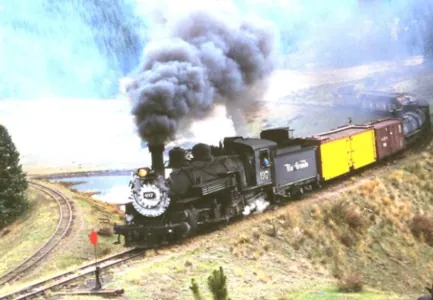
Denver & Rio Grande No. 168 a Baldwin 4-6-0 1883 pulls a classic passenger train on the
Cumbres & Toltec Scenic Railroad a few miles outside of Antonito, Colorado. This locomotive
and the passenger train is kept at Antonito and used for special events
Colorado is widely considered the narrow gauge capital of the world. This is due to the state's deep ties to 3-foot gauge railways, which were built in the late 1800s to navigate the tight curves, steep grades, and rough terrain of the Rocky Mountains. At its peak in the 1880s, the Denver & Rio Grande Railway operated a vast network of narrow gauge tracks across Colorado, which fueled the state's silver and gold mining booms. At its peak, Colorado boasted approximately 1,861 miles of interconnected narrow gauge track.
Initially built during the late 19th-century mining boom to conquer the rugged, steep, and tight switchbacks of the Rocky Mountains, today they operate as heritage tourism railways, offering scenic, steam train excursions through remote, high-altitude alpine wilderness. These legendary mountain railroads are defined by their tight curve radius, lightweight equipment, and dramatic routes originally carved into the Colorado back country. Historically the narrow track design cost significantly less to build and allowed locomotives to maneuver sharp canyons and mountain passes that standard gauge railways could not.
Our detailed narrow gauge tour of Colorado and a small corner of New Mexico will cover all of the current railroads operating on track gauges that are smaller than the standard gauge of 4' 8 1/2”. Additionally we will visit museums that feature narrow gauge locomotives and rolling stock and view equipment that is on display. To top it off we will explore a number of famous abandoned rail lines in the Rocky Mountains.
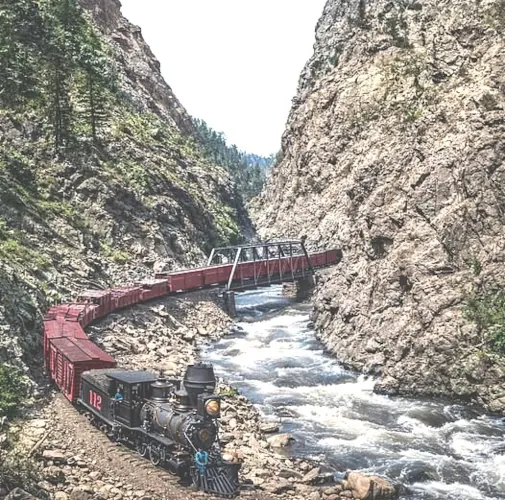
Denver, South Park & Pacific Railroad No. 112, a 2-6-0
Mogul built by Cooke in 1884 heads down the Platte Canyon
with a freight train in the 1880's. During our tour we will
explore the old right-of-way of this railroad in the Platte
Canyon area
Arrive Denver, Colorado and transfer to our hotel which is near to the Denver International Airport. Check-in at the 3 star Courtyard by Marriott Denver Airport at Gateway Park. The hotel offers a free shuttle from the airport terminal to the hotel. Plan your arrival so that you can meet your guide in at the hotel lobby at 7:00pm then go to a local restaurant or the Welcome to Colorado Dinner.
🍽 dinner
We have an early start to our day. Breakfast is available at the hotel restaurant. After checking out we have a 60 mile drive to Central City which is up in the Rocky Mountains. Upon arrival in Central City we will photograph Colorado & Southern No. 71 2-8-0 Baldwin 1896 which is on display here. Also we will visit the ongoing project to restore the original Colorado Central Railroad Depot in Central City which was built in 1879. 1,500 feet of track has been laid and work continues to make this into a railroad and mining museum. They have plans to move steam locomotive 71 and a combine passenger car from the Grand Z Casino to the depot. By August 2027 this move could very well have been completed. Their long term plans are to get the steam locomotive back operating again.
Just a few miles away in the town of Blackhawk we will take a look at another narrow gauge steam locomotive on display also with the number of 71 and lettered Colorado Central. This steam locomotive is originally from the Ferrocarril Coahuilay y Zacatecas in Mexico and is a 2-8-0 built by Baldwin in 1911.
Then there is a third narrow gauge steam locomotive in near-by Idaho Springs. This is No. 60, a 2-8-0 built by Rhode Island Locomotive Works in 1886 and is on display along with a passenger coach. We will make a stop here for some photos.
🍽 lunch
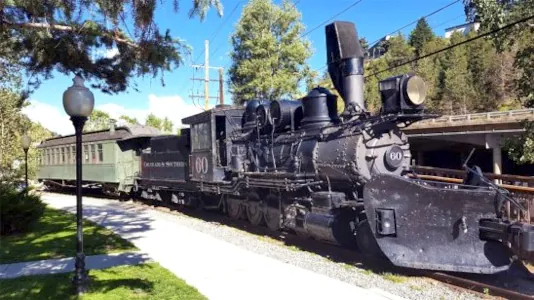
Colorado & Southern No. 60 a 2-8-0 built by Rhode Island
Locomotive Works and a passenger coach on display
in Idaho Springs
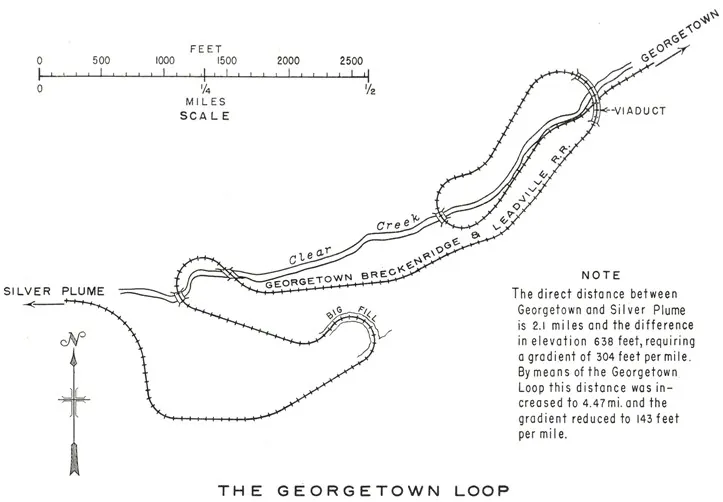
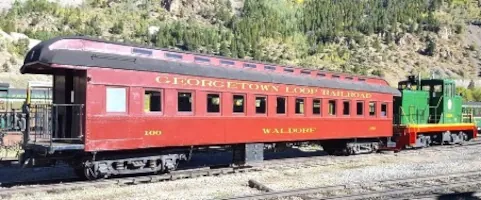
Another hand full of miles west of Idaho Springs is the historic town of Georgetown and home to the Georgetown Loop Railroad. Trains are running today and we will ride and photograph them running over the spectacular Georgetown Loop. The railroad has both steam and diesel engines but most of the time they run steam.
The Georgetown Loop Railroad is a historic, 3-foot narrow-gauge tourist line operating over 4.5-miles of track with a vertical climb of 640 feet over steep mountain grades through a spectacular corkscrew route of loops and trestles between Georgetown and Silver Plume. Originally completed in 1884 by the Georgetown, Breckenridge and Leadville Railway, the route features hairpin turns and four bridges over Clear Creek. Its crowning jewel is the Devil’s Gate High Bridge, which towers 95 feet above the canyon floor. This line was abandoned by the Colorado & Southern Railway in 1939 and the famous Georgetown Loop bridge was scraped. Then in 1984 the bridge was rebuilt for tourist trains and in 2002 it was rebuilt again to accommodate heavier engines. Today there are 4 trains scheduled to depart Georgetown for the run to Silver Plume. We will ride one of the trains and then photograph trackside the other trains. The workshops are located in Silver Plume and we will visit here to see which engines are parked outside next to the workshop building and in the yards.
The roster includes two steam locomotives and four diesels:
No. 111 is a 2-8-0 built by Baldwin in 1926 for the International Railways of Central America. She spent most of the time operating in El Salvador and only occasionally went into Guatemala. No. 111 was returned to the United States in 1973.
No. 40 is a 2-8-0 built by Baldwin in 1920 for the International Railways of Central America. She was returned to the United States in 1968.
No. 1934 is a GE center cab diesel that was rebuilt by McHugh Company for high altitude operations and was put back into service in September 2017.
No. 21 is a GE 44 ton center cab built in May 1957. It is used mostly for switching operations.
No. 130 is a GE 50 ton diesel built in 1956.
No. 140 is a GE 52 ton diesel built in 1956.
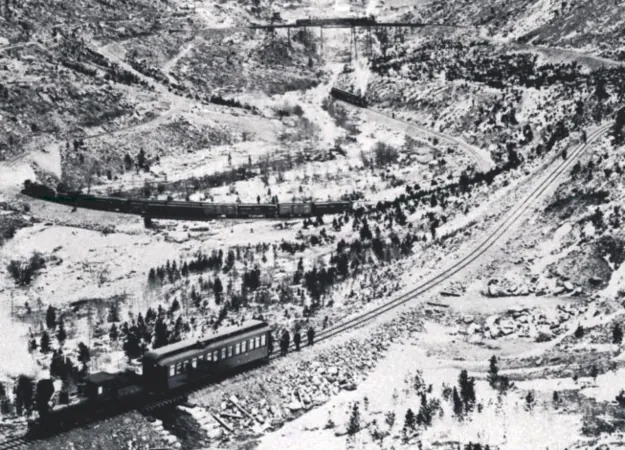
An 1880's photo of the Georgetown Loop with four westbound trains
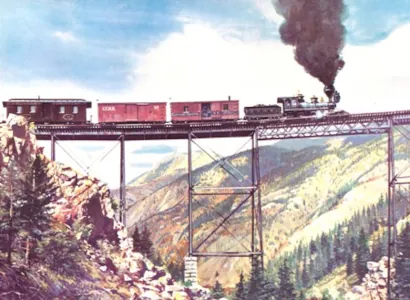
early 1880's image of a westbound train on the
Georgetown Loop. The image is a color drawing
from inside of the loop
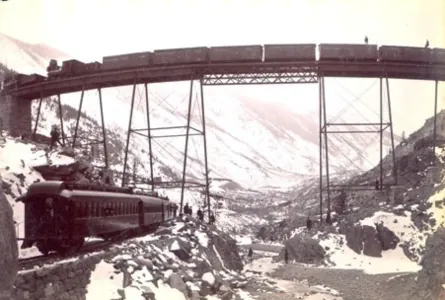
black & white photograph of westbound train from
outside of the loop with another train just
under the bridge.
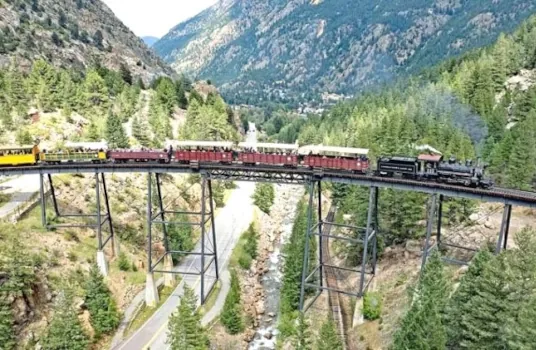
photo is of a recent tourist train crossing the Georgetown
Loop Bridge inside of the loop
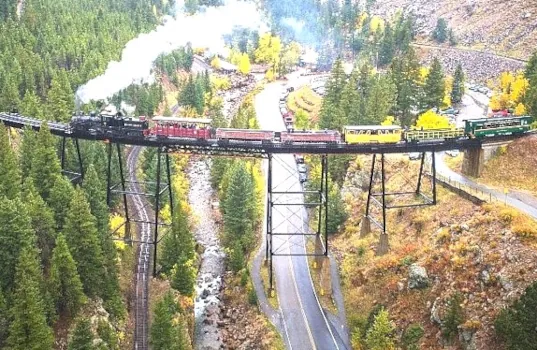
This photo was taken outside of the loop bridge
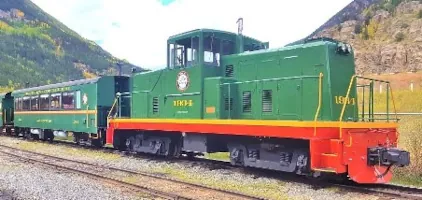
In Silver Plume diesel 1934 is a General Electric
center cab is seen with two passenger trains -
next photo
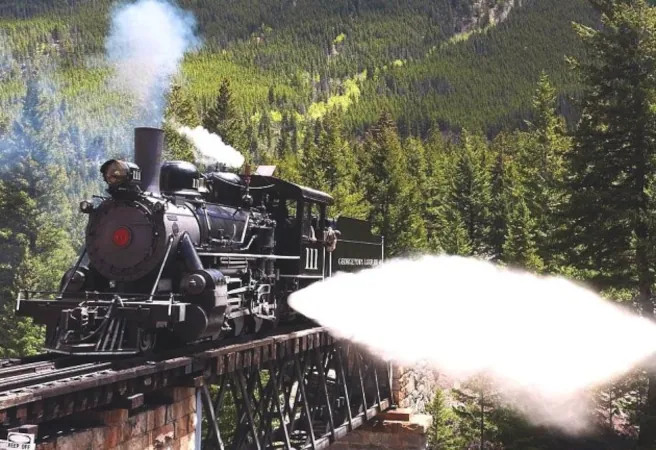
Baldwin 111 a 2-8-0 built in 1926 works hard westbound on
the steep grade to Silver Plume
After spending a good part of the day on the Georgetown Loop Railroad we travel to Breckenridge which is 34 miles from Silver Plume. Here we will visit High Line Railroad Park where steam locomotive No. 9, a 2-6-0 built in1884 by Cooke Locomotive and Machine Works and lettered for the Colorado & Southern Railroad is on display. Additionally there is a caboose, some boxcars and a rare narrow gauge rotary snowplow on display here too. After visiting this park we check-in to the 3 star Beck Inn.
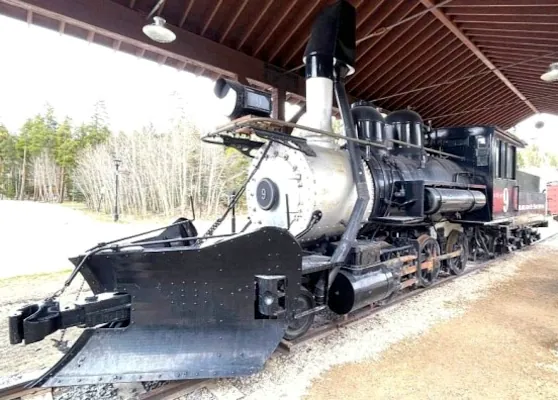
At Breckenridge No. 9, a 2-6-0 1884 by Cooke Locomotive and
Machine Works is on display
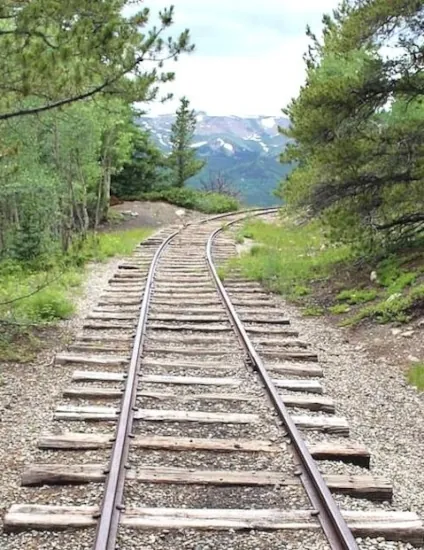
After we grab a lite continental breakfast at the hotel we check-out and follow the old narrow gauge right-of-way out of Breckenridge for the steep climb up to the Continental Divide of the Denver, South Park & Pacific Railway. We will follow this line all the way to Como, a distance of 22 road miles but for the railroad it was 63 miles. We will cross the Continental Divide at an elevation of 11,481 feet. This route was called “The Highline” by the railroad crews. At the Boreas Pass summit there was a railroad settlement called Boreas when the tracks arrived in 1882. During the height of Colorado's railroading, Boreas was a busy hamlet made up of mostly railroad and construction crews, but also served as a hostelry for weary travelers. This settlement had the highest post office in the United States in 1896. On our journey over the pass we will stop to photograph a railroad water tank still standing, a wooden box car and even some track still in place. The railroad abandoned this line in 1937. We will stop along the way to have a picnic lunch.
🍽 breakfast, lunch
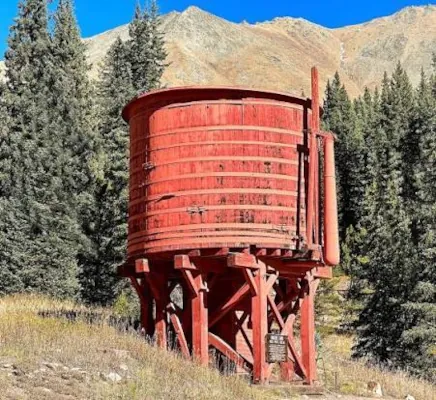
Boras Pass on the Denver, South Park & Pacific
Railway still has a water tank and even some relaid
track on the original right-of-way - next photo
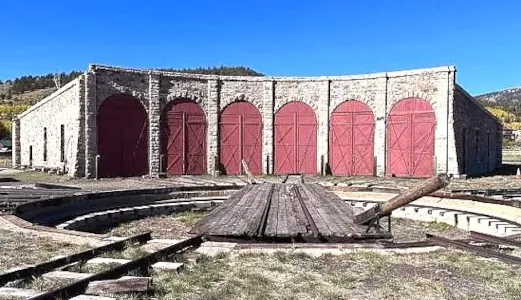
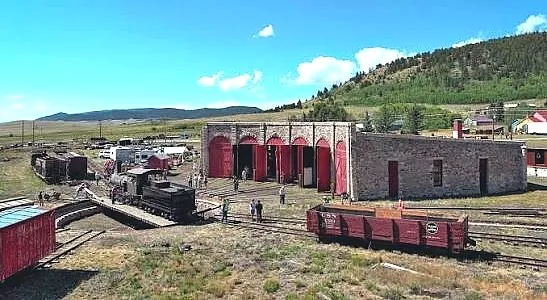
Shortly after arriving in Como around mid-day we will visit the old roundhouse, yards and depot of the Denver, South Park & Pacific Railway. The last train for Denver left Como on September 2, 1938, pulling up the track behind it under the road name of Colorado & Southern. All that remained of Como was the roundhouse, the hotel, and the depot which was built in 1879. For 60 years it was the center for trains entering and leaving town but after the last train left the old depot and roundhouse fell into disrepair. Significant restoration has taken place on these buildings over the past 45 years and now the Denver South Park & Pacific Railway Historical Society is helping restore the buildings, turntable and yards back to it's former glory. The depot is being made into a museum of South Park Railway artifacts.
There are now two engines at Como. Steam Locomotive No. 4 is a 2-6-2 built by the Baldwin Locomotive Works in 1912 for the Klondike Mines Railway in The Yukon Territory of Canada. She would work for only two years in the Territory to service the extensive gold mining claims along Bonanza Creek near Dawson City. Klondike No. 4 worked out of Dawson City and nearby Klondike City until the railway was closed down in 1913. During Wold War II this steam locomotive was shipped south by steamboat to the famed White Pass & Yukon Railway where she operated until 1952 when it was retired and put on display in Skagway, Alaska. In 1955 No. 4 was shipped south to be used on a number of smaller tourist railways before arriving in Como. Then in late 2025 a 10 ton Plymouth engine arrived at the roundhouse. Various freight cars and the Geneva which is an original DSP&P passenger car are in the rails yards.
We have requested that the steam locomotive be fired up and in operation just for our visit. The society has given their approval to have No. 4 operating in the yards including pulling a short train. We will also have the opportunity to photograph this locomotive on the turntable.
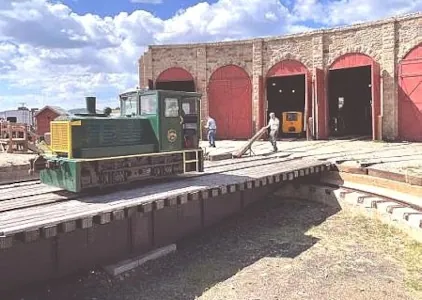
The ten ton Plymouth sits on the Como turntable
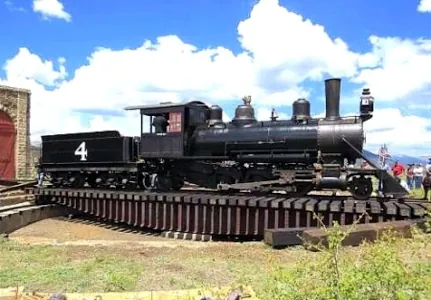
steam locomotive No. 4 sits on the Como turntable
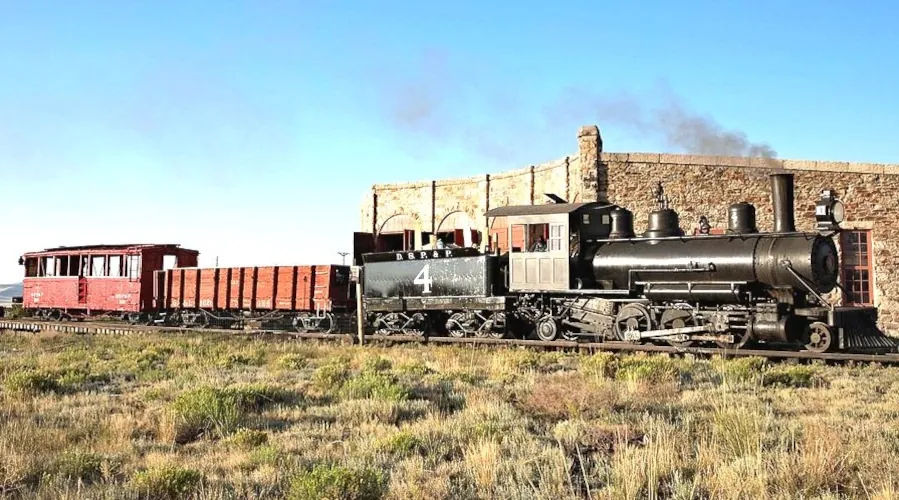
No. 4 a 2-6-2 built by Baldwin in 1912 pulls a short train in Como
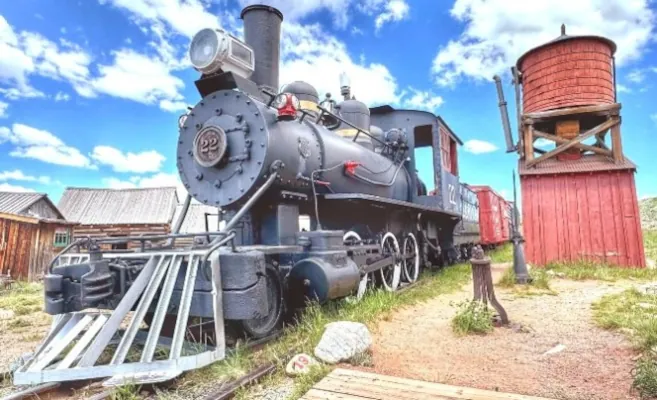
Late afternoon we will depart Como for the town of Fairplay which is only 10 miles away. Fairplay was on the mainline of the Denver, South Park & Pacific Railway. A interesting western town and museum was built here and they have a steam locomotive and several freight cars including a DRGW caboose. The name of the museum is “South Park City Museum”. This museum opened up in 1957 and they started to search for a narrow gauge train and locomotive. They had no problem finding the freight cars and caboose but the steam locomotive was a different story. Their search finally took them to Central America where they found a 2-6-0 that was similar to some of the DSP&P locomotives. They purchased this 2-6-0 for only $800 in the early 1960's. The shipping to the United States and then on to Fairplay cost the museum $9,000. No. 22 is a 2-6-0 built by H.K. Porter in 1914 and ran on a plantation railroad.
After our museum visit continue westbound for 2 ½ hour drive to Gunnision and hotel check-in at the 3 star Holiday Inn Express & Suites Gunnision.
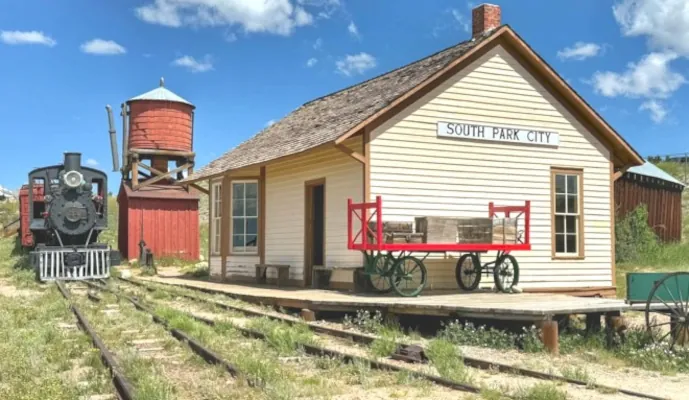
Steam locomotive No. 22 lettered for the Denver, South Park & Pacific Railway
sits on the main track in front of the South Park City Depot at the South Park
City Museum in Fairplay - next photo
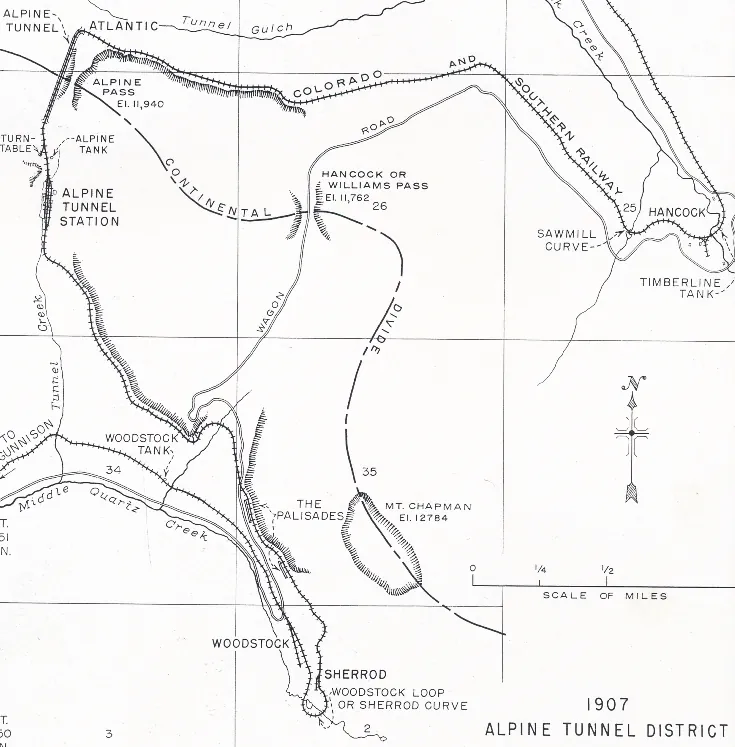
After breakfast at the hotel your guide will go pick-up one or two Jeep Wranglers as we will be going 4 wheeling high into the Colorado Rockies today. Depending upon our group size we may need to have one or two of our guides that live in Colorado help out today by driving a 2nd and perhaps a 3rd jeep. We will be spending the day exploring the old right-of-way of the Denver, South Park & Pacific Railroad line up to Alpine Pass at 11, 523 feet. This is the location of the famous Alpine Tunnel. The narrow gauge trains that ran over this route had to climb 3.5% grades on the western slope and 4% grades on the eastern slope. During our climb up to the Alpine Tunnel Station we will be driving on the old right-of-way and will see the remains of water tanks including one that is still standing, old railroad buildings, track and even a turntable. We will have our picnic lunch here.
The Alpine Tunnel is a 1,772 ft narrow gauge railroad tunnel at an elevation of 11,523 feet and it was the first tunnel constructed across the Continental Divide in Colorado and was the highest railroad tunnel in North America at the time of its construction in 1882. This line was abandoned less than 30 years later, in 1910, after a series of problems in and around the tunnel. Construction took place from 1880–1881, and was "holed through" on July 26, 1881. This was the highest and most expensive tunnel built up until that time. It is 500 feet under Altman Pass, later to be renamed Alpine Pass to prevent confusion and it took 18 months to complete. The tunnel was abandoned in 1910 by the Colorado & Southern Railroad due to some damage in the interior. This was not considered to be worth repairing due to a lack of traffic. Little remains of the station complex built by the railroad to service its trains and workers at this remote and inhospitable location. Volunteers have restored the railroad's 1883 Alpine Tunnel telegraph office and reconstructed the station platform, 120 feet of rail track, a turntable, and an outhouse. The Alpine Tunnel Historic District was placed on the National Register of Historic Places in April 1996.
🍽 breakfast, lunch
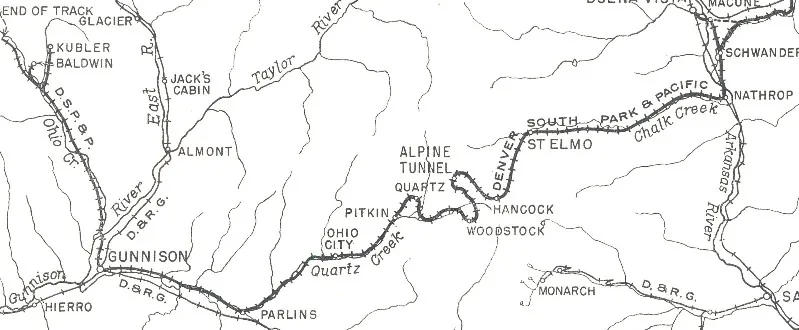
Denver, South Park & Pacific/Colorado & Southern Railway's Alpine Pine Tunnel District Maps -
next photo
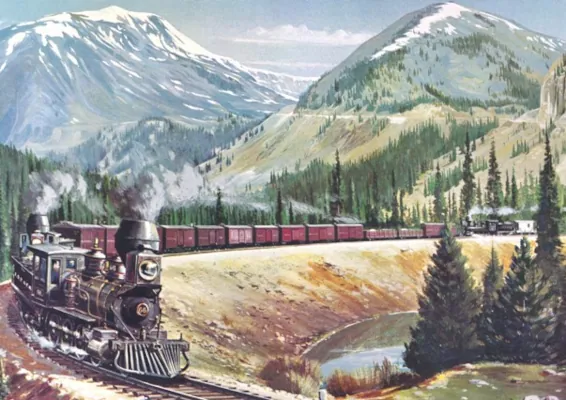
Back in the 1880's an eastbound Denver, South Park & Pacific
Railway freight train rounds the curve at Woodstock Loop as it
climbs towards the Alpine Tunnel
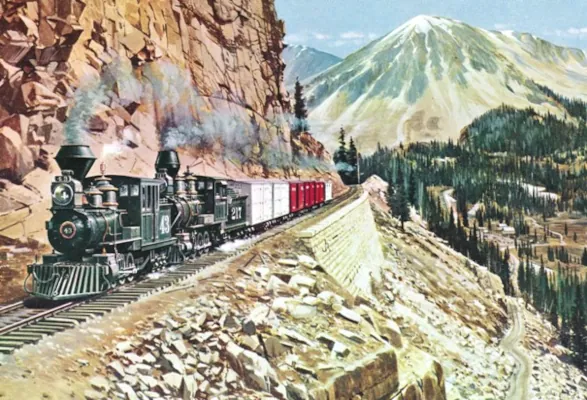
Another eastbound train passes The Palisades as it climbs
the steep grade
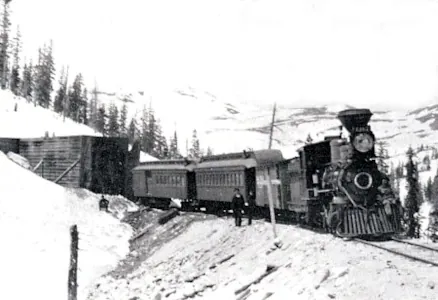
An eastbound passenger train at the east portal
in the 1880's
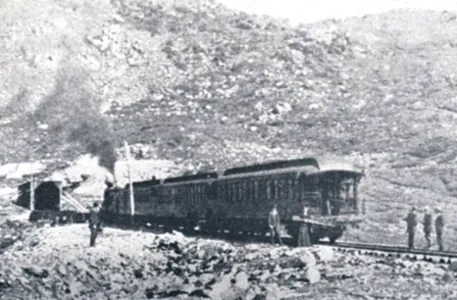
another eastbound at the west portal of the Alpine
Tunnel in the 1880's
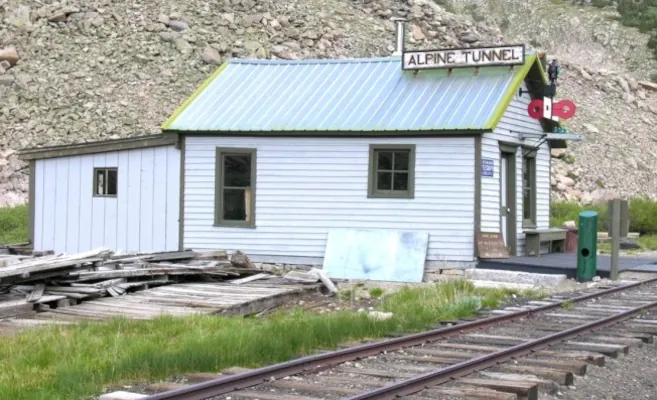
Here is the rebuilt Alpine Tunnel Station and relaid track that has been laid
near the we Portal
Mid afternoon we return to Gunnison and visit the Gunnison Pioneer Museum. They have Denver and Rio Grande Western No. 268, a 2-8-0 built by Baldwin in 1882, several freight cars and a caboose on display. They also have a preserved Rio Grande depot. This museum was opened in 1963 and the grounds feature dozens of preserved regional structures, hundreds of exhibits, and a wide variety of transportation artifacts and equipment. Railroad exhibits honor the region's indebtedness to the Denver & Rio Grande Western Railroad. After our museum visit the group will be returned to our hotel for a 2nd night and the jeeps turned in at the rental office.
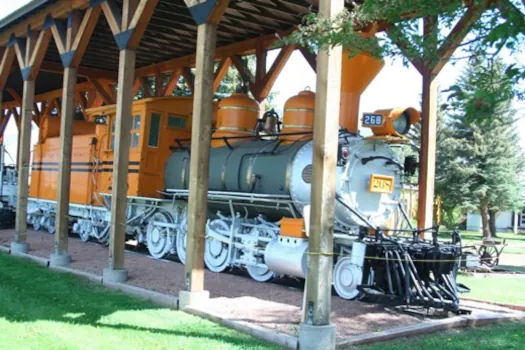
DRGW No. 268, a 2-8-0 Baldwin in 1882 at the Gunnison Pioneer Museum
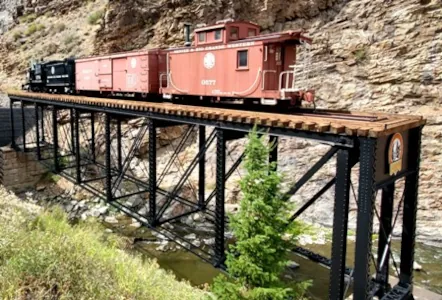
After breakfast at the hotel we head west out of Gunnision with a stop at Cimarron to view the Cimarron Canyon Rail Exhibit which features a restored narrow-gauge train of one steam locomotive, a boxcar, and a caboose sitting on top of the last railroad trestle of it's kind along the Black Canyon. The locomotive is No. 278 a 2-8-0 Baldwin 1882.
🍽 breakfast
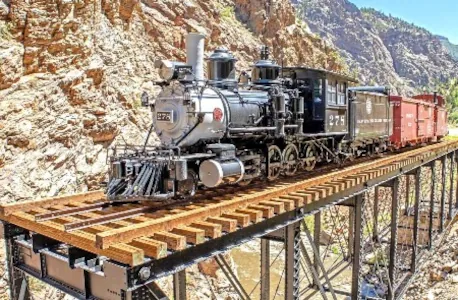
Cimarron Canyon Rail Exhibit with DRGW No. 278,
a 2-8-0 Baldwin 1882 a box car and caboose -
next photo
West of Cimarron, the original mainline of the Denver & Rio Grande Railroad climbed out of the canyon, ascended the steep slopes of Cerro Summit to an elevation of 7,950 feet then descended to Montrose. The former rail line over Cerro Summit had a ruling gradient of 4% and most freight trains required a helper locomotive. We will see sections of the right-of-way from the highway as we drive on the highway up to the summit.
Approximately an hour after departing Cerro Summit we arrive at Ridgway which is home to the Ridgway Railroad Museum. This museum is dedicated to preserving the history of railroading in Ouray County and the surrounding areas. The museum offers a 16-acre facility with a half-mile loop to operate narrow gauge equipment. The museum's main focus is on three narrow gauge lines that once ran in Ouray County. There were the Ouray branch of the Denver and Rio Grande Western Railroad which ran from Montrose to Ouray between 1887 and 1952. Prior to arriving in Ridgeway we will see the right-of-way for this line. The next line is the Silverton Railroad which ran from Silverton north to Red Mountain Pass and down into the Ironton valley from 1888 to 1923. Finally the unique Rio Grande Southern Railroad which ran from Ridgway to Durango via Telluride, Rico, and Dolores from 1891 to 1952. Ridgeway was the headquarters of the Rio Grande Southern Railroad which became famous for the Galloping Goose railcars. The museum will be operating their Galloping Goose today on their half mile loop trackage.
The equipment at this museum are:
Galloping Goose No. 4
RGS Motor No. 1, A Model T Inspection Car
PDRGW Caboose
Several Freight Cars
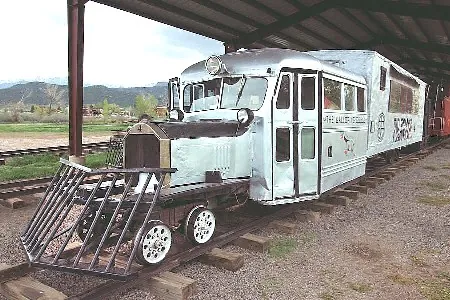
Rio Grande Southern Galloping Goose No. 4
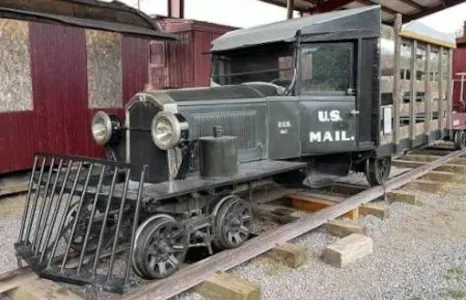
Motor No. 1 at the Ridgeway Railroad Museum
Departing Ridgeway we will follow the Rio Grande Southern right-of-way to Dolares. The RGS operated 162 miles of narrow gauge track until 1953 when the railroad went of business. There are still some depots, water tanks, and a trestle still standing and we will explore some of these historic points of interest. We will make a stop at Trout Lake where there is a water tank still standing and not far away a wooden bridge. Next we stop at Rico where a water tank is still standing. At Dolares we will visit the Galloping Goose Historical Society's depot and museum. This is home to Galloping Goose No. 5 and we can take a ride on the short section of track in front of the depot. The museum is housed in a replica of the original Dolores depot.
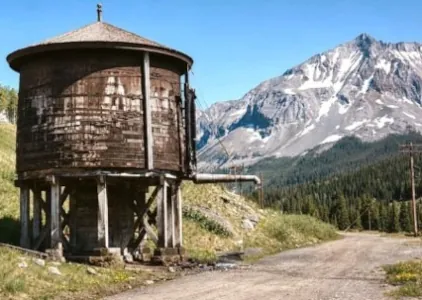
Rio Grande Southern water tank near Trout Lake
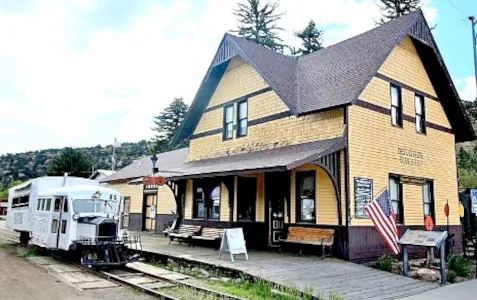
The Galloping Goose Historical Society's Depot and
Museum located in Dolores
From Dolores we head on into Durango which is approximately an hour's drive again following the RGS right-of-way. Once in Durango we check in at the 3 star Best Western Plus Rio Grande Inn which is located right next to the Durango & Silverton rail yards.
Today we will ride the famous Durango and Silverton Narrow Gauge Railroad from Durango to Silverton and return a total of 90 miles through the heart of the Colorado Rockies pulled by one of the railroad's former Rio Grande steam locomotives.
After breakfast at our hotel we will go to the depot a little early so we can visit the wonderful Durango & Silverton Railroad Museum which is attached to the workshops. You can even take a look into the old roundhouse from a viewing window within the museum and step outside to photograph the turntable. This museum has a 12,000-square-foot facility featuring authentic1880s steam locomotives, vintage coaches, an extensive model train layout, historical mining artifacts, and a cinema in a restored movie baggage car. The museum is built within 8 stalls of a 15-stall roundhouse.
We then board the first train of the day departing at 8:15am and arriving in Silverton at 11:45am. This is an unforgettable journey which takes you up into the Rocky Mountains with views of the San Juan National Forest as you travel alongside the beautiful Animas River on your way to the historic mining town of Silverton. Much of your trip today will be in the remote and rugged wilderness of the Animas River Canyon. There are no roads in this canyon and the only way in and out is by train. Upon arrival in Silverton you will step back to 1882 as you explore this classic western mining town high in the mountains of Colorado. You will have plenty of time to get some lunch before reboarding the train for the return journey at 1:45pm and arriving back in Durango at 5:15pm. Since there is two trains today after unloading we will travel a little north of the depot to photograph the 2nd train which runs 45 minutes behind our train. 2nd night at the 3 star Best Western Plus Rio Grande Hotel.
🍽 breakfast
Durango & Silverton Narrow Gauge Roster
Steam Locomotives all 2-8-2's
473 Alco K-28 1923
476 Alco K-28 1923
478 Alco K-28 1923
480 Baldwin K-36 1925
481 Baldwin K-36 1925
482 Baldwin K-36 1925
486 Baldwin K-36 1925
493 Baldwin K-37 1908
498 Baldwin K-37 1908
Diesel Locomotives
1 GE 45 ton 1957
5 GE 45 ton 1960
11 US Steel 98 ton
101 Alco MLW DL-535E 1969
103 Alco MLW DL-535E 1969
106 Alco MLW DL-535E 1969
107 Alco MLW DL-535E 1969
1201 MPES MP2000NG 2020
1202 MPES MP2000NG 2020
7 PHOTOS BELOW ARE OF THE SILVERTON TRAIN ON
THE DURANGO & SILVERTON NARROW GAUGE RAILROAD
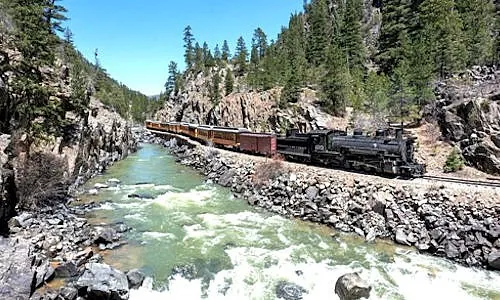
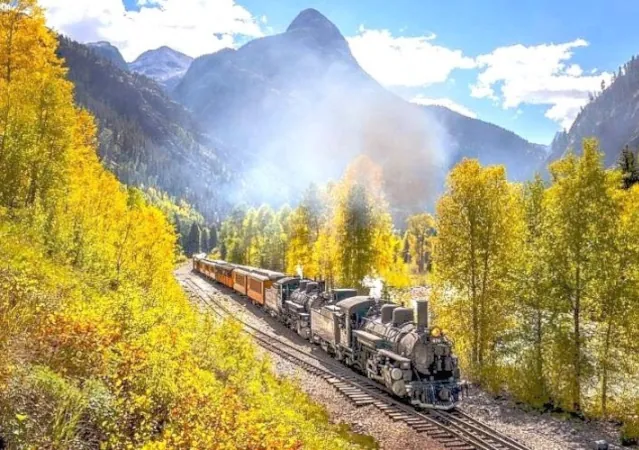
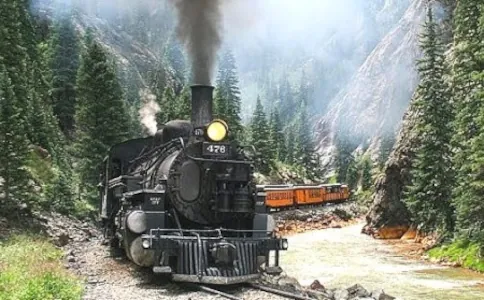
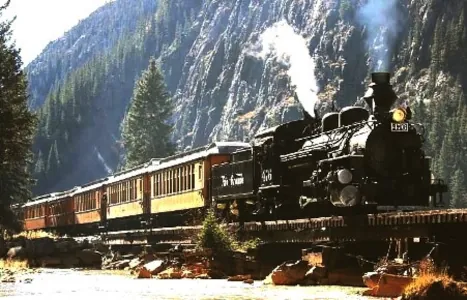
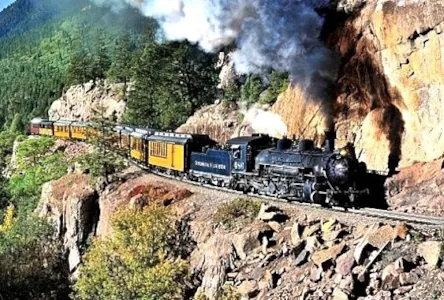
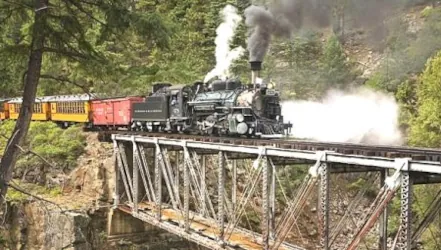
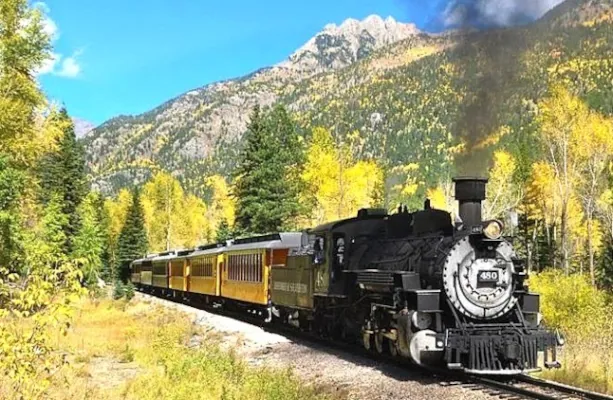
After breakfast at the hotel we will follow the first Silverton steam train which departs Durango at 8:15am. We should be able to photograph this train at 8 different locations between Durango and Rockwood. After the first train departs Rockwood we will return south towards Durango until we see the 2nd train which runs 45 minutes behind the first train. We will then follow this train to Rockwood getting several good photo locations. At Rockwood we will need to take a short hike to a spectacular overlook of the tracks. We then jump ahead of both trains by highway and get into position in the Silverton Valley for more photos. There is a nice bridge crossing the Animas River a mile south of Silverton. We will then have 45 minutes to get into a different position at this bridge for the 2nd train.
After the 2nd train arrives in Silverton we will explore the old right-of-way of the Silverton Northern Railroad which ran north to the ghost town of Eureka. The original locomotive shed is still standing in Silverton. Returning back to Silverton we then explore the old right-of-way of the Silverton Gladstone and Northerly Railroad up to the old mining town of Gladstone. From here we travel south back to Rockwood and wait for the first southbound train. This will be our last shot of the Durango & Silverton.
🍽 breakfast, lunch
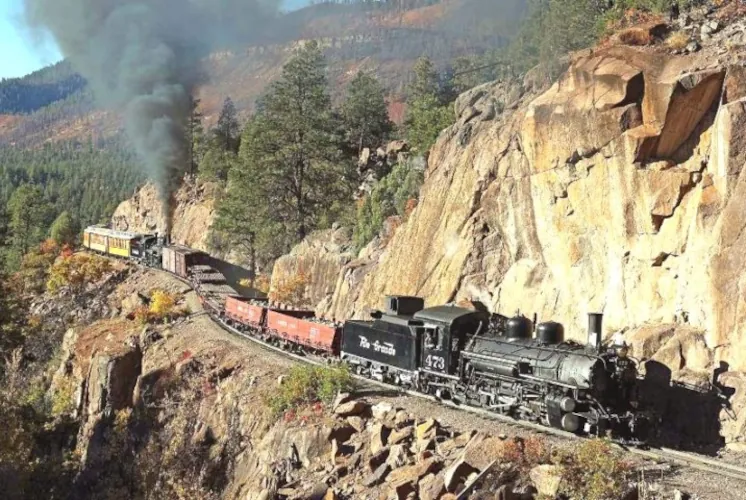
photos were taken of a special Rio Grande Photo Charter on the Durango and Silverton
Railrod. This gives you an idea of the spectacular scenery along the railroad -
next photo
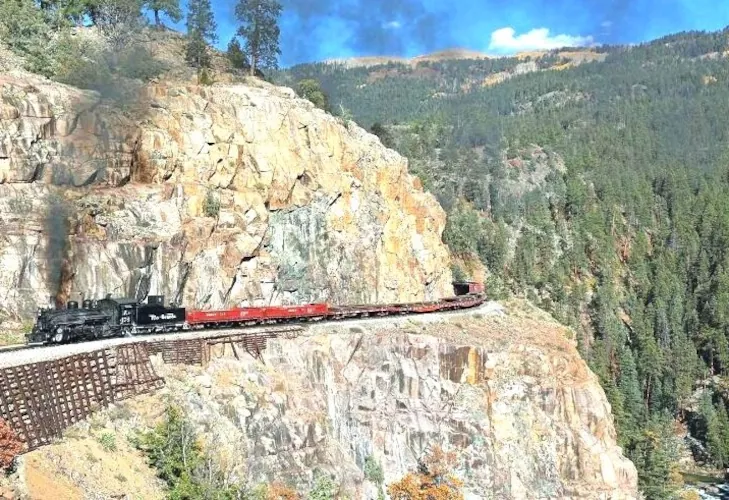
From Rockwood we head for Chama, New Mexico stopping half way for dinner. The highway follows the right-of-way of the narrow gauge San Juan Extension between Durango and Chama. This line was torn up in 1970-71. Upon arrival in Chama we will first check-in at the 2 star Branding Iron Motel. Shortly after checking-in we will offer those in the group the opportunity to visit the Chama Depot and workshops for some night photography of the steam locomotives on the Cumbres & Toltec Scenic Railroad.
Cumbres & Toltec Scenic Railroad Roster
Steam Locomotives
168 Baldwin 4-6-0 1883
463 Baldwin 2-8-2 1903
483 Baldwin 2-8-2 1925
484 Baldwin 2-8-2 1925
487 Baldwin 2-8-2 1925
488 Baldwin 2-8-2 1925
489 Baldwin 2-8-2 1925
492 Baldwin 2-8-2 1908
494 Baldwin 2-8-2 1908
495 Baldwin 2-8-2 1908
497 Baldwin 2-8-2 1908
Diesel Locomotives
No # Rogers 5Ton 2002
15 GE 47Ton 1943
19 GE 47Ton
114 BBD RSD35W 1982
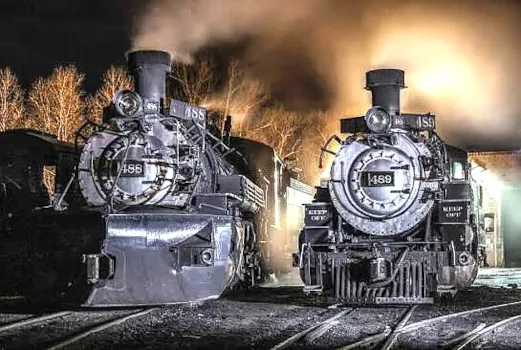
Locomotives 488 & 489 sits on the ready track at
the Cumbres & Toltec Narrow Gauge Railroad workshops
in Chama, New Mexico
In the morning we will get breakfast at a local restaurant. After breakfast you just walk across the street to the railroad depot and workshops. The train departs at 10:00am for the full day journey to Antonito, Colorado. The train will make a lunch stop at the half way mark which is Oiser. Riding the Cumbres & Toltec Scenic Railroad is a 64-mile journey back in time, traversing the remote wilderness of the Colorado and New Mexico border. This railroad has now been recognized as the longest, highest, and most authentic steam railroad in North America. The train crosses back and forth between New Mexico and Colorado 11 times reaching elevations of over 10,000 feet on 4% grades. The journey moves from alpine meadows and dense aspen forests to the sheer, dizzying rim of the 800-foot deep Toltec Gorge. You will cross the 137-foot-tall Cascade Trestle and plunge into the darkness of two historic rock tunnels. We offer an option to pace the train in our van from Chama, New Mexico to Cumbres Summit, Colorado for some fantastic trackside photos of the train working hard up a 4% grade. For the first 14 miles up to Cumbres Summit the highway follows the railroad and we will be able to catch the train at 10 locations. The train will make a short stop at Cumbres Summit to pick-up additional passengers and you then will board here. Of course you also have the option to ride the train out of Chama if you choose. The train arrives in Antonito at 4:45pm. We will be able to watch and photograph the steam locomotive being put away for the night in the workshop. There should also be at least one and maybe two additional locomotives in Antonito. Some of the trackage in Antonito is still dual gauge. We then return to Chama on the highway and have a 2nd night at the Branding Iron Motel. It takes approximately one hour to drive back to Chama from Antonito.
🍽 breakfast, lunch
This morning we will first get breakfast at the same restaurant in Chama before returning to Antonito by highway. You will make the return journey by train Antonito to Chama today. The train departs Antonito at 10:00am and arrives in Chama at 4:20pm again stopping in Oiser for lunch. The scenery is so very spectacular that you will ride both directions over the entire 64 mile line. Upon arrival in Chama we will watch the shop crews service the locomotive before returning to the motel. 3rd night at the Branding Iron Motel.in Chama.
🍽 breakfast, lunch
THE PHOTOS BELOW ARE A VARIETY OF DIFFERENT TRAINS OVER SEVERAL YEARS THAT INCLUDES SPECIAL PHOTOGRAPHERS FREIGHT EXCURSIONS WITH THE STEAM LOCOMOTIVES LETTERED FOR THE RIO GRANDE AND OPERATED BY THE SPECTACULAR CUMBRES & TOLTEC SCENIC RAILROAD
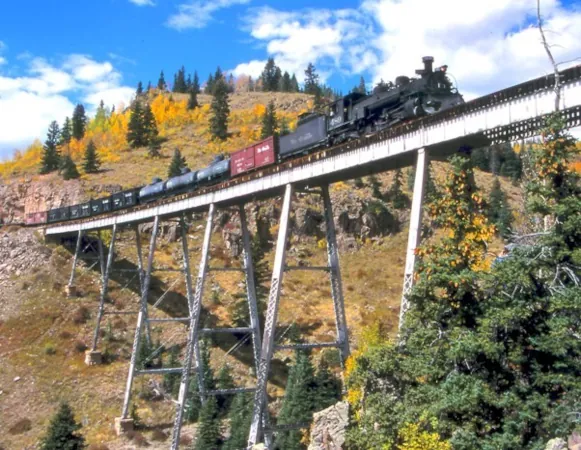
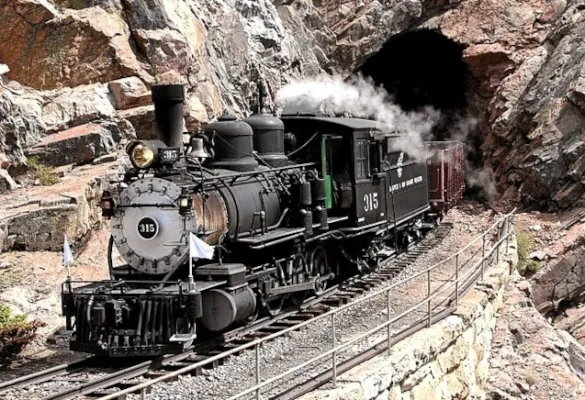
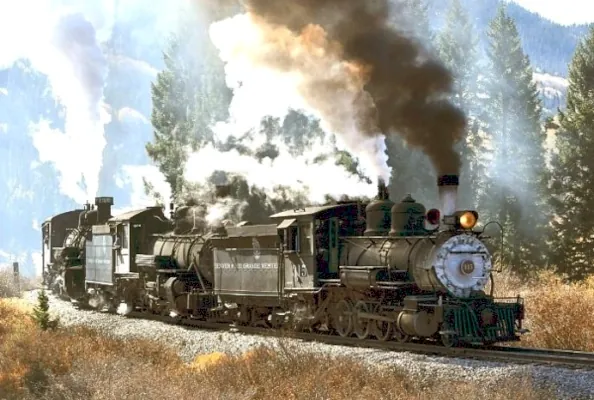
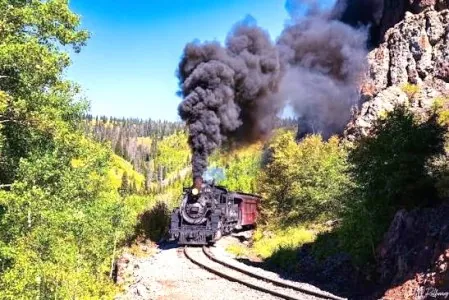
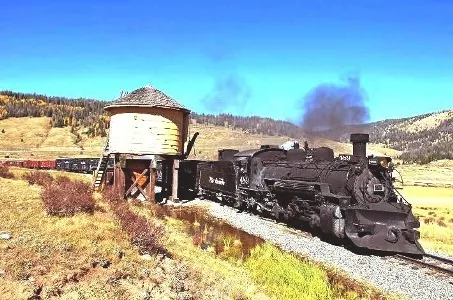
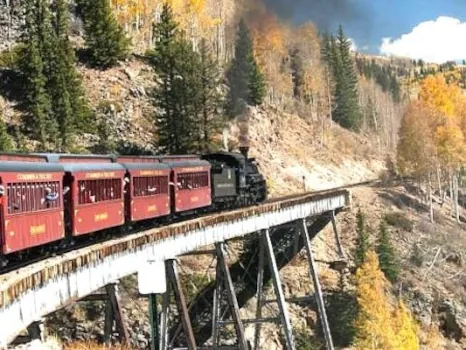
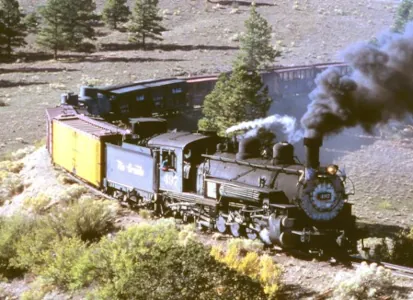
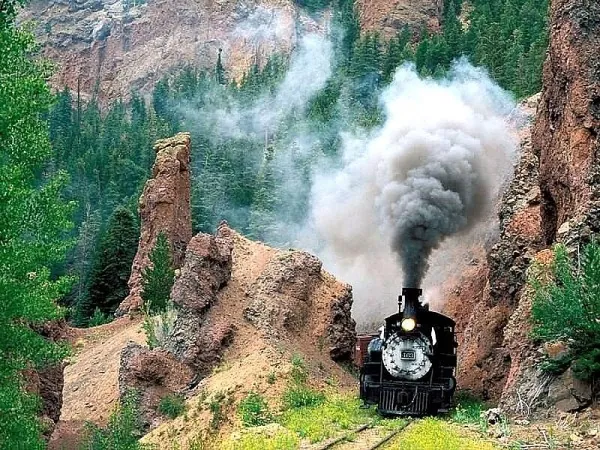
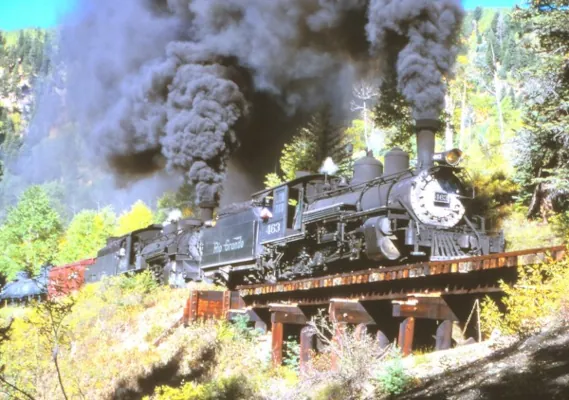
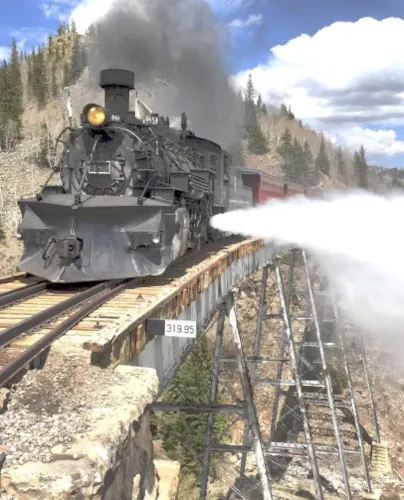
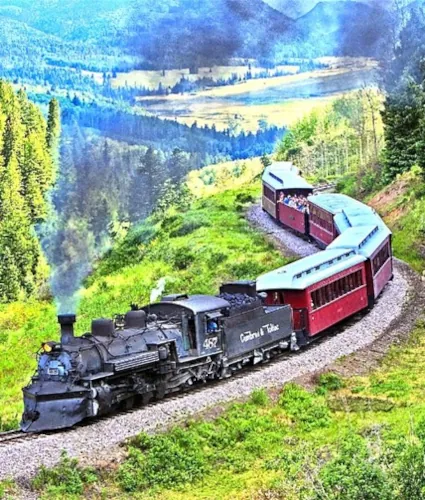
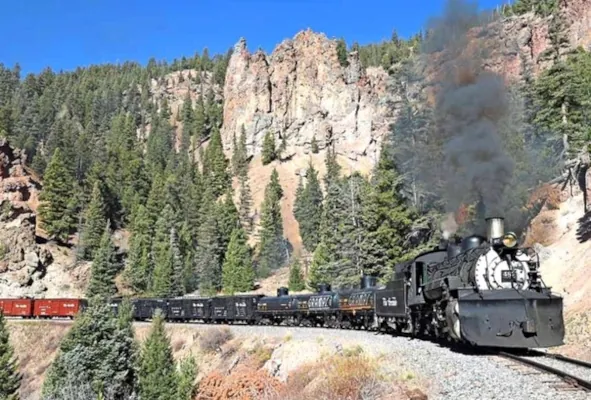
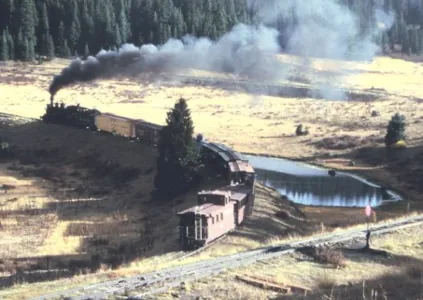
A special photographers photo freight on
Tanglefoot Curve just east of Cumbres
Summit - next photo
Again this morning we get breakfast at the same restaurant in Chama. Today we will spend most of our time trackside photographing both the Chama and Antonito trains. There are endless opportunities to catch both trains at very scenic locations. Our last couple of shots of the day on the Cumbres & Toltec will be of the eastbound train arriving back in Antonito. We then head north following the once dual gauge line which is now just standard gauge. Half way to Alamosa the La Jara Depot is still standing and once had trains from narrow and standard gauge pass through. We will stop in Alamosa to photograph DRGW 169 a 4-6-0 built by Baldwin in 1883 which is on display in a park along with a combine passenger car. We will then continue northbound across the San Luis Valley. The right-of-way for the Alamosa-Villa Grove Branch which was referred to as The Valley Line runs next to the highway across the valley. This specific stretch is famous in railroad history as "The Straightest Abandoned Track in the U.S." Because the valley floor is incredibly flat and the right-of-way runs perfectly tangent in a straight line for nearly 53 miles with no curves whatsoever. Once across the valley we start to drop down towards Salida in a canyon and if you look to the right you will see the original narrow gauge mainline of the Denver & Rio Grande Railroad between Denver and Grand Jct. In Salida we check-in at the 3 star Great Western Colorado Lodge.
🍽 breakfast, lunch
After breakfast at a local restaurant we continue our northbound trek first visiting the rim of the Royal Gorge. Perched on the rim is DRGW K-37 499 a 2-8-2. This unique locomotive was originally built as a standard gauge 2-8-0 in 1902 by Baldwin. In 1930 the Rio Grande converted it to narrow gauge.
From the Royal Gorge we continue on to Cripple Creek which is home to the two foot gauge Cripple Creek & Victor Railroad. They operate seasonal tourist trains between Cripple Creek and the city's outskirts to the south. The railroad uses a revitalized section of the original standard gauge Midland Terminal Railway and the 3- foot gauge Florence and Cripple Creek Railroad. Operations started on June 28, 1967 on two miles of track. This railroad has 7 daily departures from the Cripple Creek Station. The first train of the day departs at 10:00am and we will first take a ride then later spend sometime trackside taking pictures. The 2nd train of the day departs at 11:10am. The railroad has 5 engines, 4 steam and one diesel and the workshops is right next to the station.
🍽 breakfast
The roster is:
No. 1 Orenstein and Koppel 1902, 0-4-4-0 articulated mallet.
No. 2 Henschel 1936, 0-4-0
No. 3 Porter 1927, 0-4-0T
No. 4 Bagnall 947, 0-4-4-0T, Being restored
Diesel 1: 1951 General Electric four wheel Diesel-Electric originally battery operated for underground mine work. Currently being used by the track crews.
After taking a lunch break at one of the many restaurants in the downtown section of the town we then depart Cripple Creek and spend the rest of the day traveling to Golden. Since we will have some extra time we will follow the old right-of-way of the Denver, South Park & Pacific narrow gauge railroad in the remote Buffalo Creek, Pine Valley, and Platte Canyon areas. In Buffalo Creek, the most prominent remaining features of the railroad are the old iron truss bridge abutments over the North Fork of the South Platte River. Near Pine there are two narrow gauge wooden gons still standing on track that is still in place.
Late afternoon we will make our way out of the Rocky Mountains and into the greater Denver area. Upon arrival in Golden hotel check-in at the 3 star Holiday Inn Express & Suites Golden.
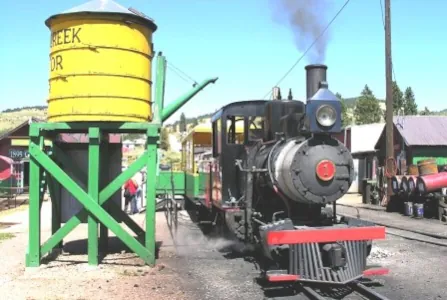
Steam Locomotive No. 1 a Orenstein and
Koppel 1902, 0-4-4-0
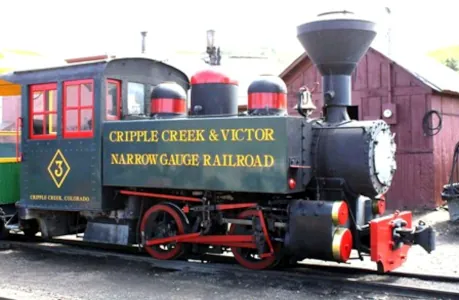
No. 3 a Porter 1927, 0-4-0T on the Cripple
Creek & Victor Narrow Gauge Railroad
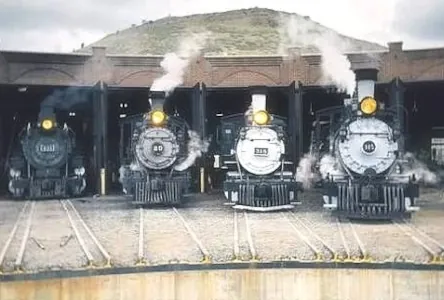
Today we will visit the Colorado Railroad Museum in Golden. This is a 15-acre open-air museum which features over 100 historic narrow and standard gauge locomotives and cars. Highlights include a replica 1880s depot, rare "Galloping Goose" railcars, and a working roundhouse. The main building was built in 1959 designed as an 1880s-style railroad station. It hosts rotating exhibits, historic photographs, an extensive research library, and an HO-scale model railroad. The on-site roundhouse features a working turntable where visitors can watch authentic restoration work in action. Below is the narrow gauge roster of the Colorado Railroad Museum.
🍽 breakfast, dinner
There is also standard gauge equipment on display.
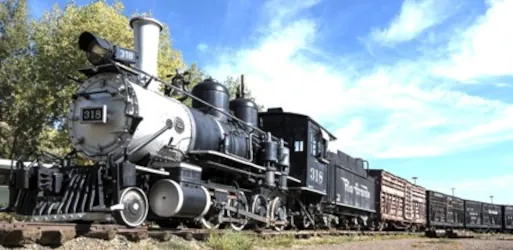
DRGW 318 2-8-0 Baldwin built 1896
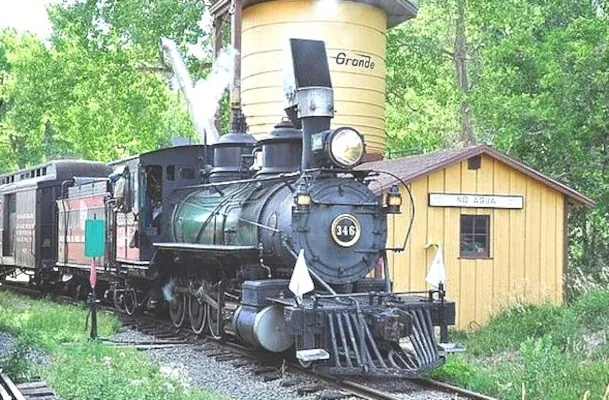
DRGW 346 2-8-0 Baldwin built 1881
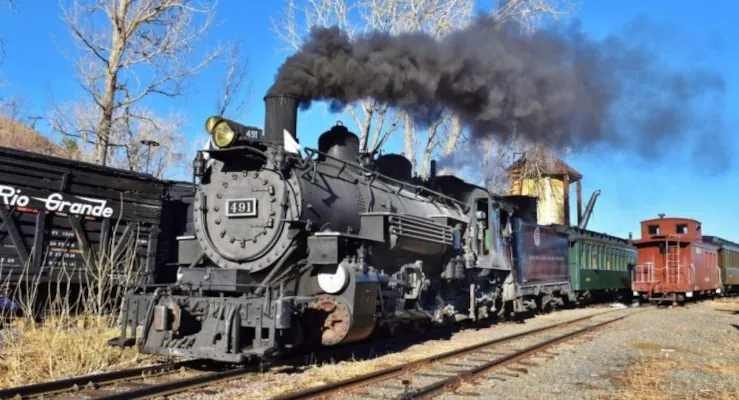
DRGW 491 2-8-0 DRGW built 1928
RGS 20 4-6-0 Schenectady built 1889
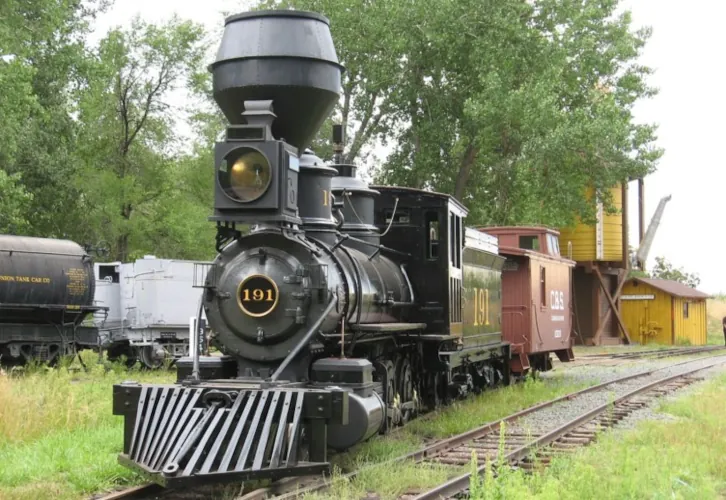
DL&G 191 2-8-0 Baldwin built 1880
GC&SJ 4 55 Ton GE built 1966 (Golden City & San Juan)
DRGW 50 0-4-0 Davenport built 1937
RGS Galloping Geese 2-6 & 7
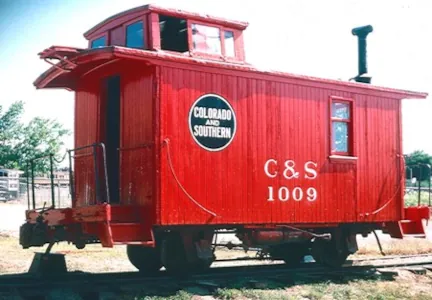
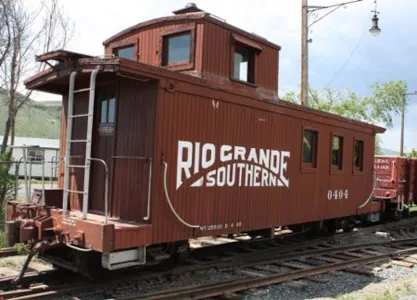
THE PHOTOS BELOW ARE FROM THE COLORADO RAILROAD MUSEUM IN GOLDEN, COLORADO A GOLD MINE OF NARROW GAUGE EQUIPMENT
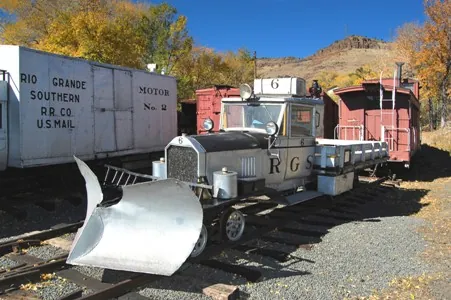
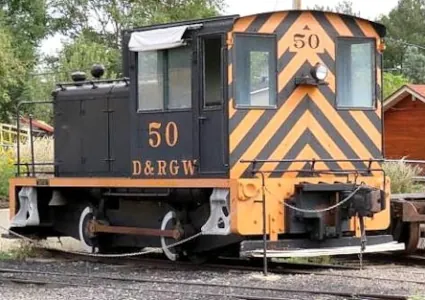
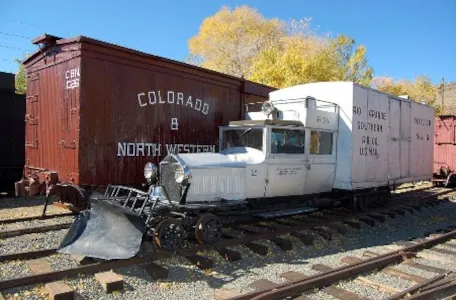
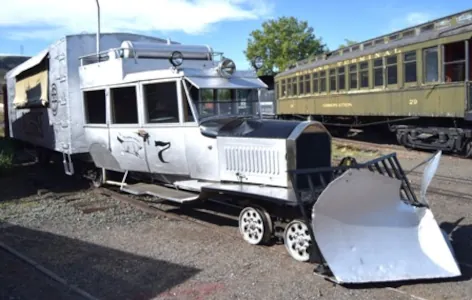
After a leisure breakfast at our hotel and we check-out at approximately 9:30am to visit the Forney Transportation Museum in Denver. This interesting museum has three narrow gauge pieces of equipment.
🍽 breakfast
There are:
No 7 0-4-0T – Henschel - built 1930 (Operated in Denmark)
No. 1 0-4-4T – Porter - built 1897 (Operated on a Plantation)
No. 10501 Caboose - built 1919 (Operated on the Colorado & Southern RR)
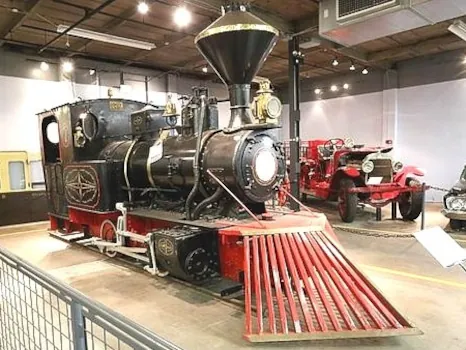
Narrow gauge No. 7 a 0-4-0T built by Henschel 1930
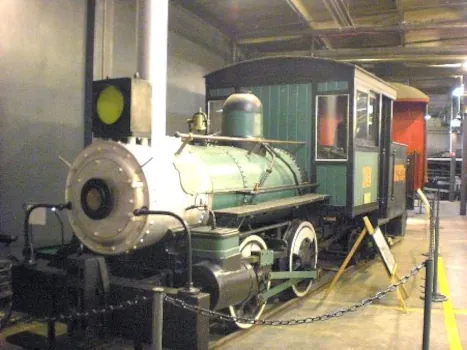
No. 1 a 0-4-4T built by Porter in 1897 on display at the
Forney Transportation Museum in Denver
After departing from the Forney Transportation Museum we will go directly to the Denver International Airport and we plan to be there by 12:01pm. You can plan your flights home to depart Denver anytime after 3:00pm. End of our tour.
TOUR CONDITIONS PRICING - PLEASE READ CAREFULLY
Tour Pricing:
All tour prices are subject to change without notice, at any time. All prices based on double room occupancy. We reserve the right to change tour prices if it becomes necessary and is beyond our control. If payments are made by credit card a 3% conveyance fee will be added.